 English


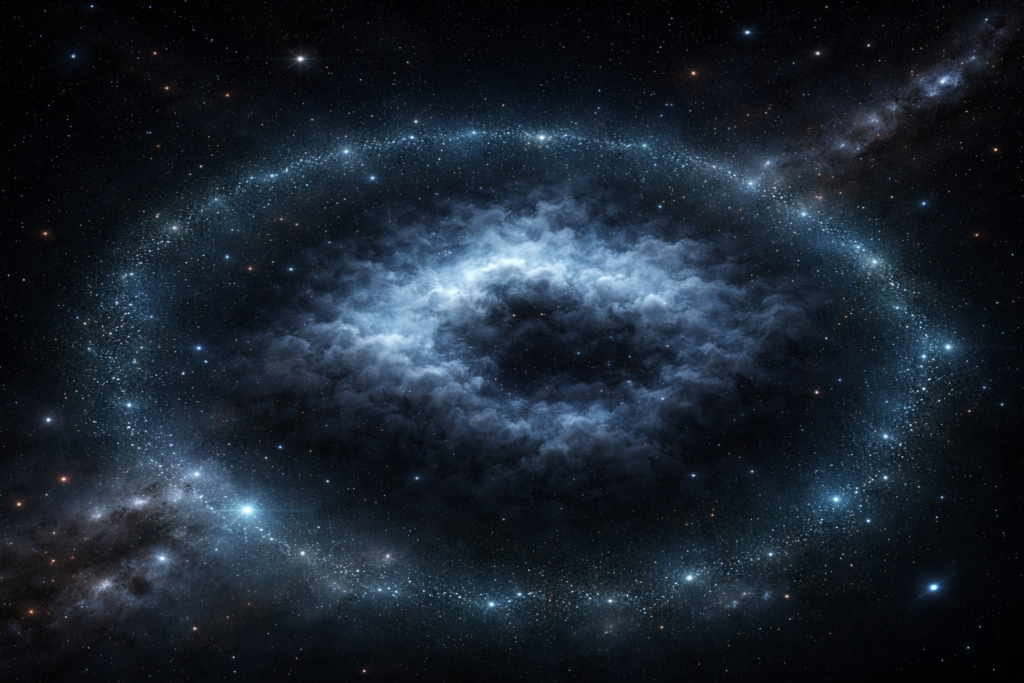
Imagine standing under a dark night sky, looking up. You see stars, you see galaxies, you see a universe full of light. Now pause for a moment and imagine something just as real, just as massive, but almost completely invisible. No stars, no glow, no sparkle. Yet it exists. That is the story of “Cloud-9”.
NASA and ESA, through their joint mission using the Hubble Space Telescope, have confirmed the existence of a strange cosmic object that quietly deepens our understanding of the universe. This object is called Cloud-9. It is not a star, not a planet, and not a normal galaxy as we usually imagine one. Scientists describe it as a “failed galaxy”, something that started the journey of becoming a galaxy but never completed it.
In simple terms, the story of a galaxy usually goes like this. Gas gathers in space. Dark matter provides an invisible framework. Gravity pulls everything together. Gas becomes dense and cold enough, and stars are born. Those stars shine, light spreads, and a galaxy appears. Cloud-9 is a story that stopped halfway. The gas is there. The dark matter is there. Gravity is there. But stars never formed.
Cloud-9 lies about 14 million light years away from us. That distance is so vast that even if it were glowing, its light would take millions of years to reach Earth. But the deeper truth is that there are no stars inside it to produce light at all. What Cloud-9 contains is mostly neutral hydrogen gas, the basic raw material from which stars are usually made. This naturally raises a question. If the ingredients were present, why did stars never form.
The answer takes us back to the early universe. When the universe was very young, it went through a phase known as reionization. During this time, the first stars and galaxies released enormous energy, heating the surrounding gas. Many small gas clouds could not survive this heat. Their gas never cooled enough or became dense enough to ignite star formation. Cloud-9 appears to be one of these survivors, a structure frozen at an early stage of cosmic history.
In size, Cloud-9 is far from insignificant. Its central region spans about 4,900 light years. The mass of hydrogen gas inside it is roughly a million times the mass of our Sun. Even more striking is the invisible component. Surrounding this gas is a massive halo of dark matter, estimated to weigh around five billion Suns. In other words, what we cannot see is what truly holds this object together.
Confirming Cloud-9 was not easy. It was first detected through radio observations, because hydrogen gas reveals itself at radio wavelengths. But radio signals alone cannot tell us whether stars exist. For that, astronomers needed extremely sensitive vision. Hubble was pointed toward the region and took deep images. Those images confirmed that there are no stars inside Cloud-9. The tiny points of light seen within its outline turned out to be distant background galaxies, far beyond it.
This discovery matters because it turns long standing theory into observable reality. For decades, scientists have predicted that the universe should contain dark matter dominated structures with little or no stars. Cloud-9 is the first clear, confirmed example of such an object. It reminds us that the universe is not defined only by what shines. Much of its true structure lives in darkness.
The meaning of this is quietly profound. The universe is like a half read book. Some pages are bright and easy to understand. Others are written in invisible ink. Objects like Cloud-9 allow us to feel those hidden pages. They tell us that creation is not just a story of stars and galaxies, but also a story of unseen matter that silently shapes everything we know.