 English


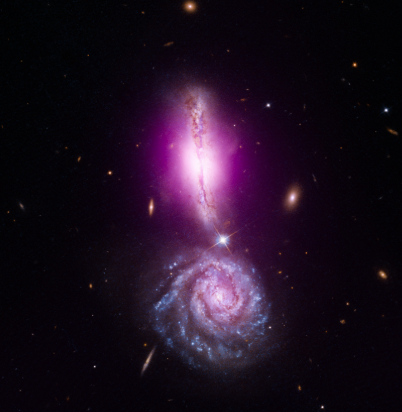
We think that nothing can be more powerful than a nuclear bomb, but the universe repeatedly reminds us how limited our thinking really is. Recently, scientists have observed one such phenomenon, one that is releasing energy equal to about ten quintillion hydrogen bombs every single second. This is not an explosion that ends in a moment, but a continuous cosmic process, unfolding relentlessly.
This extraordinary event has been observed in a nearby galaxy called VV 340a. At first glance, this galaxy may appear calm and ordinary, but deep inside it, a force is at work that can change the fate of the entire galaxy. In this discovery, the extension of human vision has been the James Webb Space Telescope, which is revealing what was once hidden behind dust and darkness.
At the center of VV 340a lies a massive black hole. Black holes are often imagined as monsters that swallow everything, but the reality is far more fascinating. When gas and dust approach a black hole, they do not fall straight in. Instead, they spiral around it, heating up, glowing intensely, with some material finally falling inward while a significant portion is hurled outward at incredible speeds. This ejected material forms what scientists call jets.
To understand the power of these jets, comparison becomes necessary. According to scientists, the energy flowing out from VV 340a every second is equivalent to the simultaneous detonation of ten quintillion hydrogen bombs. The number is so enormous that the human mind struggles to grasp it. This does not mean that explosions are happening there constantly, but rather that an immense amount of energy is being released continuously, as if an invisible engine has been switched on in the middle of the universe.
The key strength of the James Webb Telescope lies in its infrared vision. Ordinary telescopes observe visible light, but much of the universe is filled with dust that blocks this light. Infrared light can pass through dust with ease. This is exactly what happened in VV 340a. Where earlier telescopes saw almost nothing, Webb revealed vast clouds of extremely hot gas with remarkable clarity. These clouds extend on both sides of the galaxy and are so long that they rival or even exceed the size of the entire galaxy itself.
These gas clouds are not like ordinary smoke. The gas is so hot that its atoms have been stripped apart, leaving it in a highly ionized state known as coronal gas. Normally, such gas remains confined close to a black hole, but here it is spreading thousands of light years into space. It is as if the heat from a single stove were somehow spreading across an entire city.
Another astonishing aspect of this phenomenon is that the jets are not traveling in straight lines. Instead, they trace out a spiral like pattern as they move forward. This motion is known as jet precession. To visualize this, imagine a spinning top. As it spins, it wobbles slightly, and its axis slowly shifts direction. In much the same way, the jets emerging from the black hole gradually change their orientation over time. This is the first time such large scale precessing jets have been observed in a disk shaped galaxy.
The impact of this process goes far beyond producing striking images. It directly affects the future of the galaxy itself. Every year, VV 340a is losing gas equal in mass to about nineteen stars like our Sun. This gas is the raw material from which new stars are born. When the black hole heats this gas and expels it outward, the formation of new stars within the galaxy can slow dramatically or even come close to stopping altogether.
In this way, the black hole is not merely a destructive force, but also a regulator. It helps determine how and when a galaxy grows, how rapidly stars are formed, and what the galaxy’s long term future will be like. This perspective forces us to see the universe as an interconnected system, where an invisible object at the center of a galaxy can influence the lives of millions or even billions of stars.
The greatest significance of this discovery is that it shows us the universe is not static. It is constantly changing, flowing, and reshaping itself. Instruments like the James Webb Telescope are allowing us to understand that we are not just observing stars and galaxies, but witnessing the deeper rules of time, energy, and nature itself. The event unfolding in VV 340a reminds us that we are part of a universe far more powerful, complex, and mysterious than we ever imagined.