 English


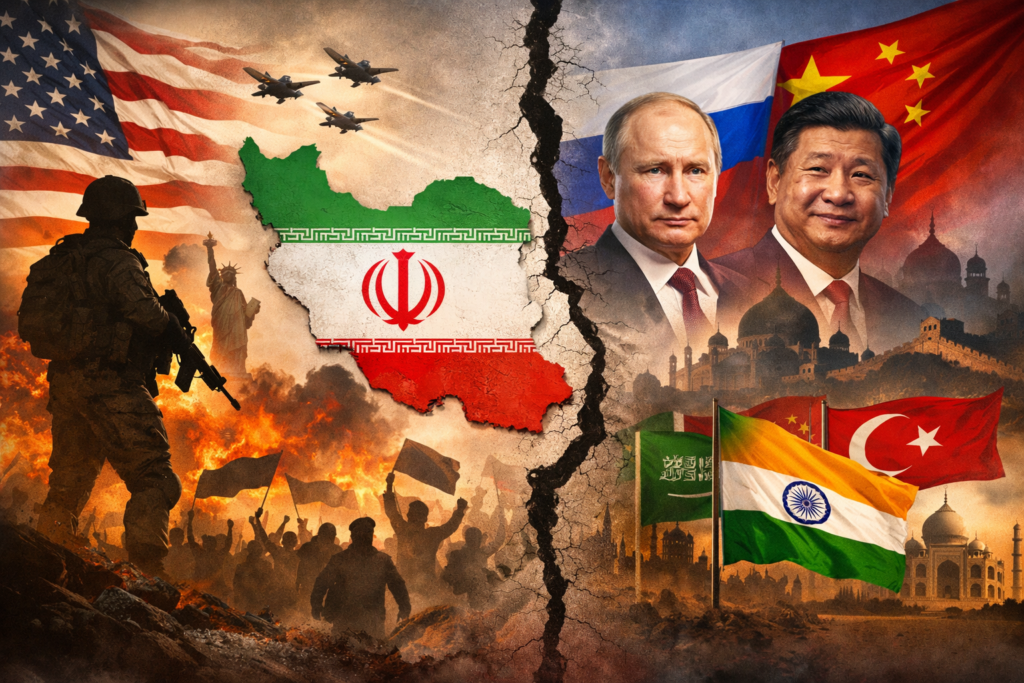
The anti-government protests in Iran and discussions around a possible US military action have raised a key question about where the world’s major countries stand in the current situation and who wants to maintain a balance. Some countries are openly aligning with the United States, some are offering diplomatic support to Iran, while many are trying to stay away from confrontation to protect their national interests. In this context, India’s role also becomes important, as it has traditionally followed a policy of balancing its relations with both Western countries and Iran.
Amid widespread protest movements in Iran, the United States is projecting power and considering military options. This stance is linked to the shared interests of the US and its key allies such as Israel, as both seek to limit Iran’s nuclear program and its influence in the Middle East. During this period, several Western powers have stated that diplomatic solutions should be prioritized over military strikes, but the US approach indicates that it wants to politically isolate Iran.
Russia, China, and Iran’s traditional partners
Russia and China have continued to express verbal support for Iran and are opposing US military intervention. For both countries, Iran is a geopolitical partner that helps create a counterbalance against Western pressure. However, their support is limited, and they have signaled that they do not intend to enter into direct military confrontation. Even so, at the diplomatic level, they continue to stand by Iran.
Turkey and the regional response: opposition to intervention but keeping distance
Turkey has clearly stated that it opposes military intervention in Iran and prioritizes stability. This policy makes it clear that Turkey does not want to be involved in a major conflict, even as the United States applies pressure at the international level. In addition, Saudi Arabia and some Arab countries have also not offered clear support or military backing, as their focus is more on preventing the conflict from spreading to their own borders.
Pakistan and the mixed stance of the Muslim world
Many Muslim-majority countries have called for resolving regional conflicts through diplomatic means and avoiding any large-scale war. Pakistan has also emphasized the need to prevent escalation and has adopted a strategy of not standing directly with either side. Meanwhile, some communities and religious leaders have urged countries like India to support Iran, but this does not reflect official state policy.
India’s position: balance and challenges to national interests
India is not taking a clear military side in this crisis and is generally emphasizing diplomacy and peace. India and Iran share long-standing economic and geopolitical ties, such as the Chabahar Port project, but due to US pressure and sanctions, India is compelled to pursue a balanced policy. According to experts, India will have to make decisions keeping its national interests and strategic autonomy in mind, as distancing itself from a strategic partner like Iran could also impact India’s broader regional interests.