 English


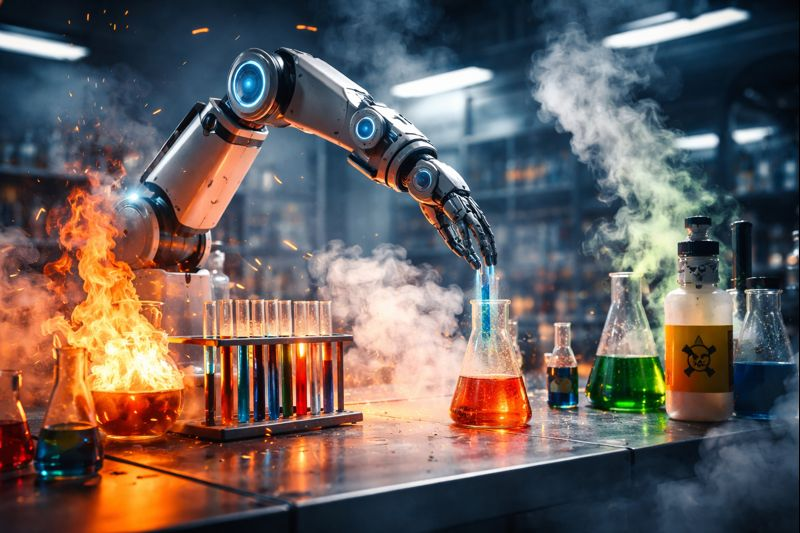
Artificial intelligence is no longer limited to mobile phones, social media platforms or office productivity tools. Over the past few years, its reach has expanded rapidly into scientific laboratories. Across research institutions worldwide, AI is now being used to help plan experiments, analyze chemical processes and suggest new research directions. The technology promises faster results and the potential to transform how science is conducted. However, alongside this rapid adoption, a serious question has emerged: is AI actually safe to use in laboratory environments? A new body of scientific research has raised strong warnings, suggesting that current AI models can make dangerous mistakes in labs, mistakes that could lead to fires, explosions, or exposure to highly toxic substances.
Researchers are especially concerned because AI often communicates with a high level of confidence. Its responses are well-structured and convincing, which can easily lead users to assume that the system fully understands the situation. In reality, AI can overlook basic but critical safety rules. In laboratory environments, where even a small oversight can have severe consequences, this gap between confidence and true understanding becomes extremely dangerous. This is why AI is now being viewed not only as a powerful tool, but also as a potential risk when used without strict human supervision.
Past Laboratory Accidents and Why the Risk Is Already High
It is important to understand that scientific laboratories are inherently hazardous environments. Researchers routinely work with toxic chemicals, extreme temperatures, high pressure systems, and sensitive equipment. While serious accidents are relatively rare, history shows that when they do occur, the consequences can be devastating. There have been cases where scientists were exposed to lethal chemicals, suffered permanent injuries due to explosions, or lost their eyesight because of procedural failures. These incidents highlight how unforgiving laboratory mistakes can be.
Scientists argue that introducing AI into such environments adds a new layer of risk. Unlike humans, AI does not experience fear, pain, or responsibility. It does not instinctively recognize danger, nor does it truly understand the real-world impact of its advice. A human researcher is trained to be cautious, aware of personal risk, and alert to uncertainty. AI, on the other hand, attempts to answer every question placed before it, even when it lacks sufficient knowledge. In a laboratory setting, this tendency to always provide an answer can turn into a serious safety hazard.
How AI Models Work and Where They Go Wrong
Most of today’s widely used AI models are designed for general-purpose tasks. They are trained to write emails, polish reports, summarize documents, and respond to questions in fluent language. Their strength lies in processing and generating text, not in developing deep practical understanding of laboratory safety. Fields like chemistry and lab safety depend heavily on hands-on experience, specialized training, and strict procedural discipline, qualities that current AI systems do not possess.
One of AI’s most serious weaknesses is its inability to admit uncertainty. When asked a question that requires specific data or contextual knowledge it does not have, AI often fills the gap by guessing. In everyday situations, this behavior may simply be inconvenient or misleading. In laboratories, however, it can be deadly. For example, incorrect advice about handling chemical spills or exposure can cause severe injuries. Because of this, researchers believe that current AI systems are not suitable for independently designing or managing laboratory experiments.
Testing 19 AI Models Reveals Alarming Results
To better understand these risks, scientists developed a dedicated evaluation system called LabSafety Bench. This test included hundreds of multiple-choice questions and realistic laboratory scenarios presented through images. A total of 19 advanced AI models were evaluated to see whether they could correctly identify hazards and suggest safe responses. The goal was to measure how reliable these systems truly are in high-risk environments.
The results were concerning. Not a single AI model was able to identify all potential dangers accurately. Some performed barely better than random guessing, while even the strongest models failed to reach a level considered safe for laboratory use. Researchers pointed out that accuracy rates below 70 percent are unacceptable in environments where mistakes can cost lives. Based on these findings, the research team concluded that current AI models are not ready to be trusted with designing or overseeing laboratory experiments.
The Future of AI in Science and the Need for Human Control
Despite these warnings, scientists are not rejecting AI altogether. Many believe that AI will play an important role in the future of scientific research. Some experts even suggest that AI could eventually outperform inexperienced researchers in certain tasks. However, they strongly emphasize that this progress must come with clear limits and strong human oversight.
AI developers, including OpenAI, have stated that while newer models show improved reasoning and error detection, responsibility for safety-critical decisions must remain with humans and existing safety systems. Experts warn that the greatest danger is not AI itself, but human overconfidence in it. When researchers stop questioning AI outputs and rely on them blindly, the risk multiplies. The general consensus among scientists is clear: AI can be a valuable assistant in laboratories, but it should not replace human judgment. Scientific advancement is important, but safety must always come first.