 English


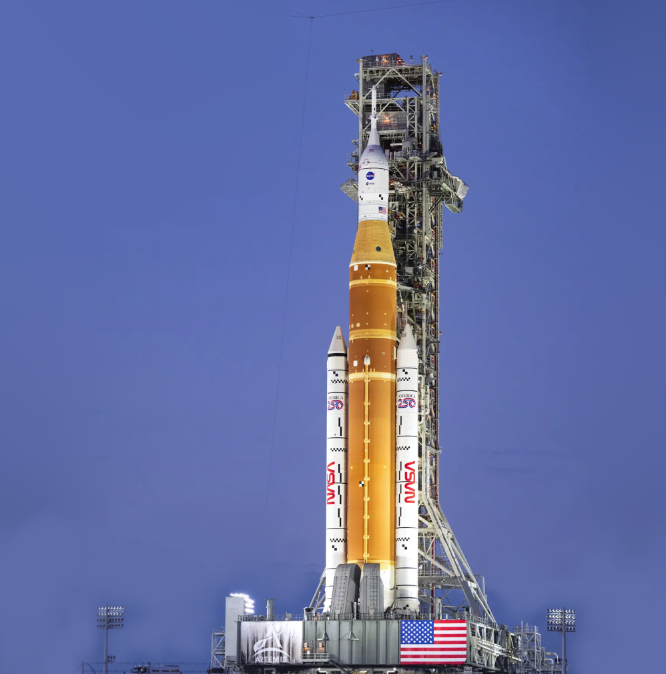
The ambitious Artemis II mission of the U.S. space agency NASA has reached a crucial phase. The Space Launch System rocket and the Orion spacecraft have been successfully installed at Launch Complex 39B at the Kennedy Space Center in Florida. The process was completed at 6:42 p.m. EST on Saturday, January 17, 2026. With this, the formal countdown for the first crewed Artemis mission toward the Moon is considered to have begun. This mission is part of NASA’s long-term plan to send humans back to the Moon and eventually prepare for human missions to Mars.
Nearly 12-Hour Rollout, Distance Covered at Extremely Slow Speed
The process of transporting the Space Launch System rocket and the Orion spacecraft from the Vehicle Assembly Building to the launch pad was extremely complex and time-consuming. The entire journey took nearly 12 hours to complete. NASA’s crawler-transporter 2 carried the massive rocket across a distance of about four miles. Its top speed was just 0.82 miles per hour, ensuring that no stress was placed on the rocket or spacecraft structure. After exiting the high-bay doors of the Vehicle Assembly Building, the rollout was paused briefly so teams could make necessary technical adjustments to the crew access arm. This structure allows astronauts and closeout crews to enter the Orion spacecraft on launch day.
Focus Shifts to Wet Dress Rehearsal, A Launch-Day Style Practice
After reaching the launch pad, engineers and technicians are now fully focused on preparing for the wet dress rehearsal. This test is considered one of the most critical steps before the actual launch. During the rehearsal, the rocket will be loaded with cryogenic, extremely cold propellants, the entire countdown sequence will be carried out, and then the propellants will be safely drained. The goal of this exercise is to accurately simulate every activity planned for launch day, allowing teams to identify and address any potential technical issues in advance. NASA has indicated that more than one wet dress rehearsal may be conducted if required. If additional inspections or repairs are needed during testing, the rocket and spacecraft could be rolled back to the Vehicle Assembly Building.
Four Astronauts, Lunar Flyby and Safe Return as the Goal
The Artemis II mission will carry four astronauts. NASA Commander Reid Wiseman, Pilot Victor Glover, and Mission Specialist Christina Koch will fly alongside Canadian Space Agency Mission Specialist Jeremy Hansen. The mission is expected to last about ten days, during which the spacecraft will travel around the Moon and then safely return to Earth. Throughout the mission, the crew will test the Orion spacecraft’s systems, study the effects of human presence in deep space, and evaluate procedures related to long-duration space travel.
A Key Milestone in Preparation from the Moon to Mars
Artemis II is not being viewed merely as a test flight, but as the foundation for future human landing missions. NASA’s objective is to establish a long-term human presence on the Moon, which will serve as a stepping stone for missions to Mars. Data gathered from this flight will be used in planning future lunar landing missions, surface habitation strategies, and astronaut safety measures. According to NASA, the Artemis program marks the beginning of a new era in human spaceflight, aimed at developing the Moon into a permanent scientific and technological hub.