 English


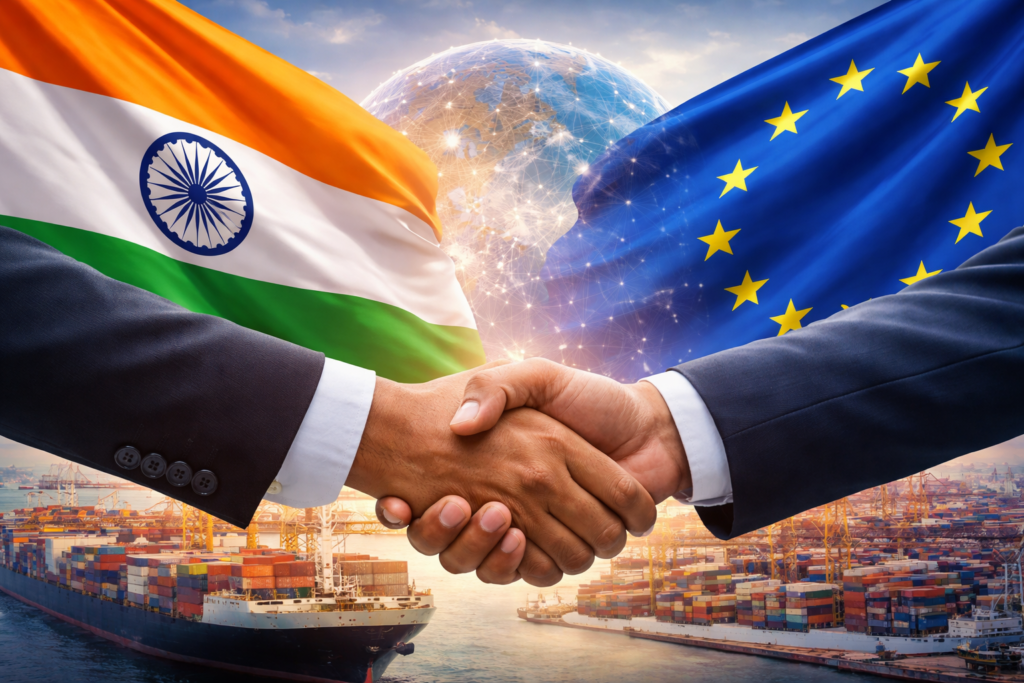
Amid shifting global economic and geopolitical dynamics, the proposed free trade agreement between India and the European Union has reached a decisive stage. At the World Economic Forum summit in Davos, European Commission President Ursula von der Leyen gave strong indications regarding the deal. She said that the India-EU trade agreement is so wide-ranging that some are calling it the “Mother of All Deals.” The agreement would create a shared market of nearly 2 billion people and represent almost one quarter of global GDP. Her statement in Davos is being seen as especially significant because Ursula von der Leyen is scheduled to visit India next week. This visit comes at a time when negotiations on the free trade agreement between India and the 27-nation European Union have reached their final phase, and a major announcement is expected at the India-EU summit on January 27.
Why the India-EU agreement is being seen as historic
This proposed trade agreement is not limited to tariff reductions alone. Its scope extends across goods, services, investment, the digital economy, clean energy, pharmaceuticals, and advanced manufacturing. India is among the world’s fastest-growing major economies, while the European Union remains a key hub of global trade. This deal is emerging at a time when governments worldwide are reassessing supply chain dependencies. For the European Union, India has become a crucial part of its strategy to reduce reliance on China and expand trade with trusted partners. For India, deeper access to this large 27-country market would boost export competitiveness and provide an opportunity to move up the global value chain.
A long journey since 2007
Negotiations on the India-EU free trade agreement began in 2007. In the initial years, several rounds of talks were held, but due to regulatory differences and disagreements over tariffs and market access, the process remained stalled for nearly a decade. Momentum returned in 2022. This time, the talks were given a more modern structure, going beyond customs duties to include issues such as digital governance, emerging technologies, and supply chain resilience. Around the same time, the India-EU Trade and Technology Council was launched, which helped build trust on sensitive technical and regulatory matters. This gave new direction to the negotiations and helped broaden the scope of the agreement.
Population and market strength
The biggest strength of this agreement lies in its vast consumer base. The combined population of India and the European Union is close to 2 billion. This is why it is being regarded as one of the largest potential markets in the world. Such a massive consumer base could become a major attraction for global companies, investors, and manufacturing sectors. For this reason, the deal is being described as one that could influence nearly one quarter of global GDP.
Trade figures and growing compulsions
Bilateral trade between India and the European Union has already reached record levels. In 2023, trade in goods stood at around 124 billion euros, while trade in services, led by digital and IT services, was estimated at nearly 60 billion euros. Experts believe that a formal free trade agreement could multiply these figures several times, particularly in areas such as clean energy, digital services, and advanced manufacturing.
Several hurdles still remain
Despite the optimism seen in Davos, several challenges persist. The European Union is seeking deep tariff cuts from India on automobiles, wine, and spirits, sectors that India has traditionally protected to safeguard domestic industries. On the other hand, India wants more favorable conditions for the mobility of skilled professionals, but visa and labor mobility remain politically sensitive issues within European countries. In addition, matters related to sustainability standards, access to public procurement, and regulatory alignment are yet to see final agreement.
Republic Day, defence, and geopolitics
This year, European Union leadership is set to attend India’s Republic Day celebrations as chief guests. On January 26, a military contingent from EU countries will also take part in the Republic Day parade, an event being seen as historic. Alongside this, the India-EU summit scheduled for January 27 is expected to include discussions not only on trade but also on defence and security cooperation. In the context of changing global geopolitics, this partnership is being viewed as an important step toward balancing the influence of major powers such as the United States and China.
What lies ahead
The India visit of Ursula von der Leyen and European Council President Antonio Costa is being seen as decisive. According to diplomats, the visit could provide an opportunity to resolve politically sensitive issues that remain stuck. If the agreement is finalized, it would not only elevate India-EU relations to a new level but also bring about a significant shift in the global trade order.