 English


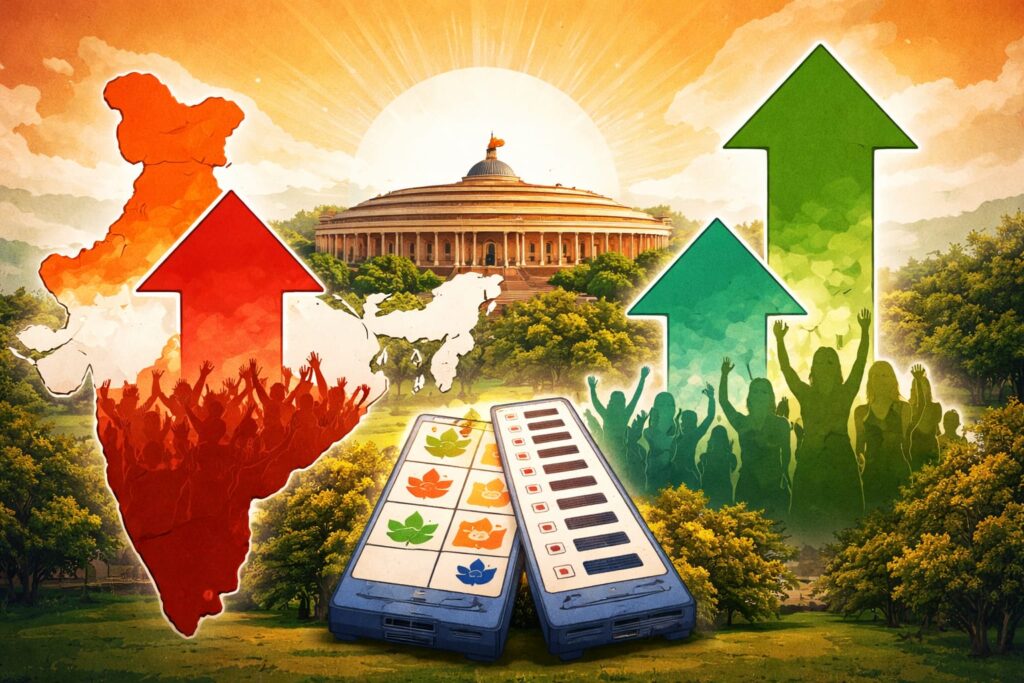
After 2026, a major political upheaval may take place in the country. The issue of delimitation or the redrawing of Lok Sabha constituencies is no longer just a constitutional debate but has become a direct battle over power and representation. According to Articles 81 and 82 of the Constitution after every census the redistribution of Lok Sabha seats and changes in constituency boundaries can be carried out. However this process was halted in 1976 and was later extended until 2026.
Now the issue of women’s reservation has also become linked to this and this has made the political atmosphere even more heated. In 2023 under the Nari Shakti Vandan Act the path was cleared for 33 percent reservation for women in the Lok Sabha and state assemblies. But the biggest condition was that a new census would be conducted first followed by delimitation and only then would women’s reservation be implemented. This is why despite the promise of reservation for women its benefits have not yet been visible on the ground.
Recently the central government introduced the 131st Constitutional Amendment Bill 2026 to speed up this process. Under this, it was proposed to increase the total number of Lok Sabha seats from 543 to around 850 and reserve one-third of them for women. The government argued that this would allow women’s reservation to be implemented before the 2029 elections and would also improve representation.
However, the opposition described this not merely as women’s reservation but as politics of delimitation. Several opposition parties alleged that in the name of women’s reservation there is an attempt to alter the political strength of states. States in South India particularly fear that despite their success in population control their influence in Lok Sabha seats may decline while larger states in North India may benefit more. West Bengal Chief Minister Mamata Banerjee also openly opposed this and stated that women’s reservation should be kept separate from delimitation.
The bill failed to secure the required two-thirds majority in Lok Sabha. While 298 members supported it, 230 voted against it and the bill was defeated. Following this, Prime Minister Narendra Modi apologized to women and said that the government would remove every obstacle to ensure they receive their rightful share. The opposition responded that their fight is not against women’s reservation but against changing the political balance through delimitation.
This is why delimitation in 2026 is no longer just about the mathematics of seats. It has become the biggest political issue that will determine women’s representation, the balance of power between North and South India, and the direction of the 2029 elections. In the coming months, it will decide whose voice will be stronger in Parliament and in which direction India’s democracy will move forward.